VA Disability Claim Denied? What to Do Next With a Supplemental Claim
Most denials come down to one missing piece of evidence. Learn how to read your decision letter, what counts as new and relevant evidence, and how to file a Supplemental Claim before the one-year deadline.
8 min readBy Azimuth Team
Share
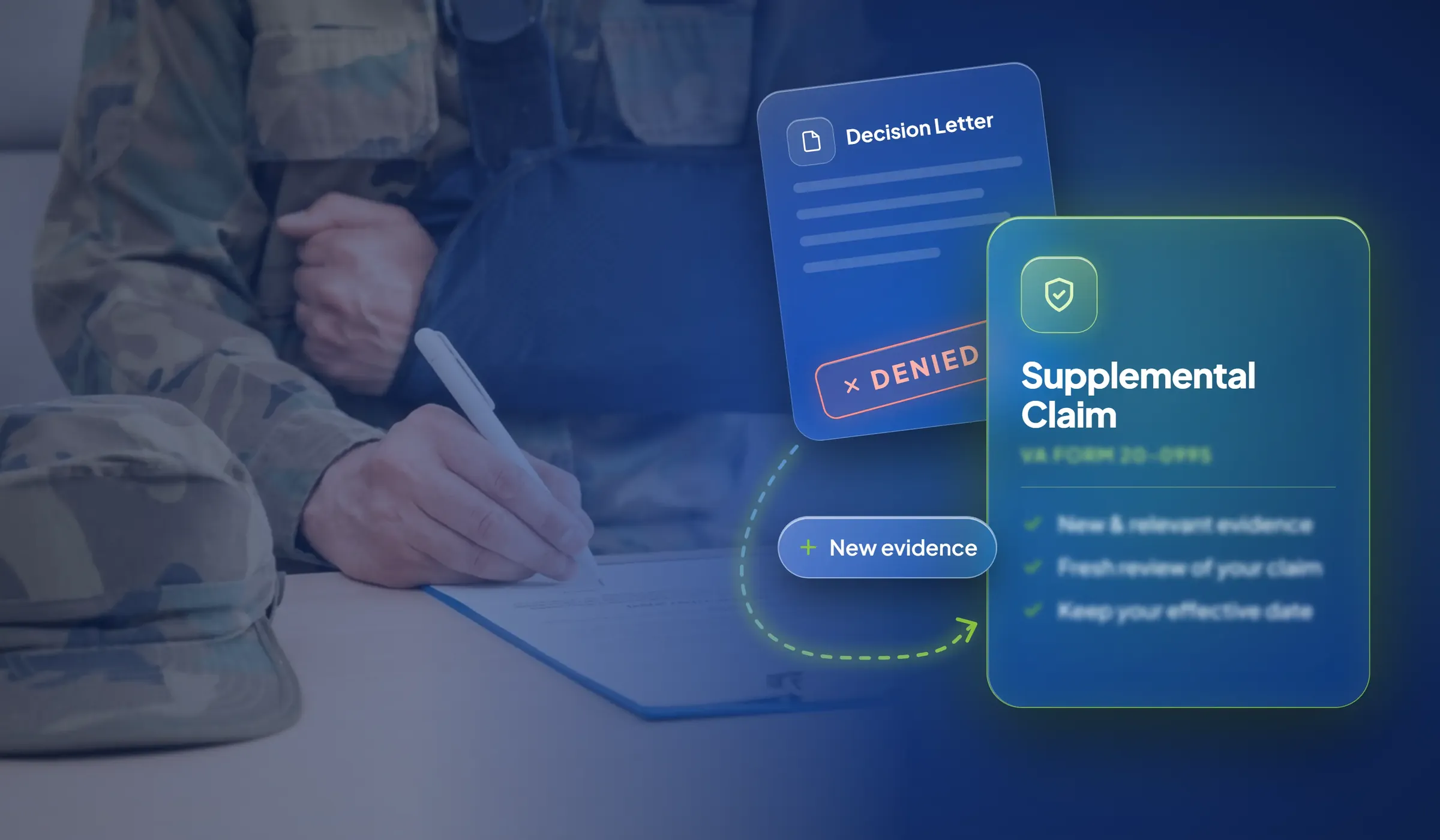
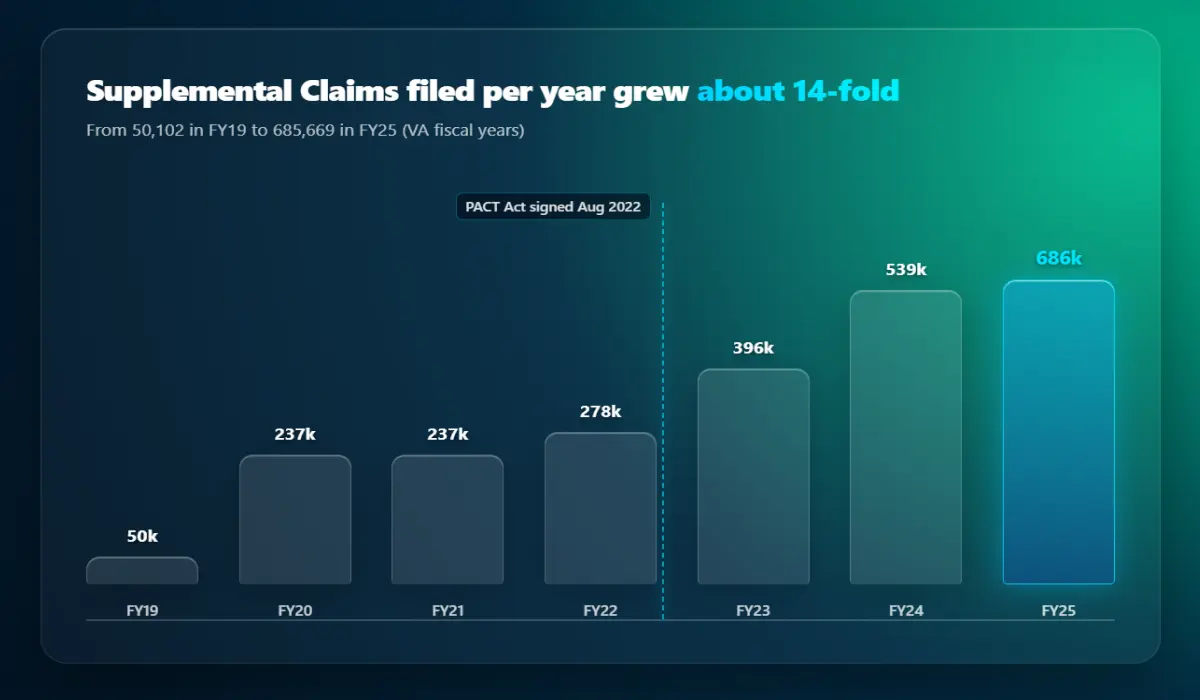
If your VA disability claim was denied, a supplemental claim is often the fastest way to fix it. In fiscal year 2025, veterans filed 685,669 Supplemental Claims (opens in new tab), and VA granted 48.2% of them.
This review asks VA to decide your VA disability claim again after you add new and relevant evidence. By the end of this guide, you will know why VA denied your claim, which evidence supports that denial, and how to file a supplemental claim before the deadline that protects your back pay.
Read the “reasons for decision” in your decision letter to find the missing piece.
Get new and relevant evidence that fills it, such as a nexus letter, a buddy statement or new medical records.
File a supplemental claim on VA Form 20-0995 within one year of the decision to protect your effective date.
Attend any compensation & pension (C&P) exam VA schedules, then track your VA disability claim on VA.gov. In September 2026, VA averaged 58.3 days to decide one.
Why was my VA disability claim denied?
Most denials mean VA did not find proof of one or more of the required elements. A denial in no way indicates that VA thinks you are not hurt. To grant service connection, VA needs three things: a current diagnosis; an in-service event, injury or exposure; and a medical link (the “nexus”) between them.
The most common reasons a VA disability claim is denied are:
No current diagnosis: Symptoms were described, but no provider formally diagnosed the condition.
No proof of an in-service event: Service records do not mention the injury, incident or exposure.
No nexus: No medical reason can be found that connects your condition today to your service.
A negative C&P exam opinion: The examiner determines that your condition was “less likely than not” related to service.
A missed compensation and pension exam: VA denied the claim on the evidence it already had.
A low rating: You were service-connected, but the rating understates how the condition limits you.
Your decision letter names the reason under “reasons for decision” and lists the evidence VA reviewed. Whatever is missing from that list is what your new filing has to supply.
What is a supplemental claim?
A supplemental claim is a request for VA to review a past decision on your VA disability claim (opens in new tab) because you have new and relevant evidence or a change in law now covers your condition. It is one of three decision review options created by the Appeals Modernization Act of 2017, and it is filed on VA Form 20-0995.
VA’s duty to assist applies here again. That means VA must help collect records you identify, including private records you authorize on VA Form 21-4142.
A change in law can also support the claim without new evidence. The PACT Act, for example, added more than 20 presumptive conditions (opens in new tab) for burn pit, Agent Orange, and other toxic exposures.
There is, however, one exception: if a rated condition has simply gotten worse, VA says to file a claim for increased compensation instead. If you have never claimed a condition, you file a VA disability claim for it on VA Form 21-526EZ (opens in new tab).
What counts as new and relevant evidence?
VA defines new evidence (opens in new tab) as information it has not considered before, and relevant evidence as information that proves or disproves something in your claim.
Counts?
Example
Yes
A private medical opinion linking sleep apnea to service-connected PTSD
Yes
A buddy statement from someone who saw your in-service back injury
Yes
Treatment records dated after your last decision
No
A second copy of service records VA already reviewed
No
A letter that only says you disagree, with no new facts
Supplemental Claim vs Higher-Level Review: Which should you choose?
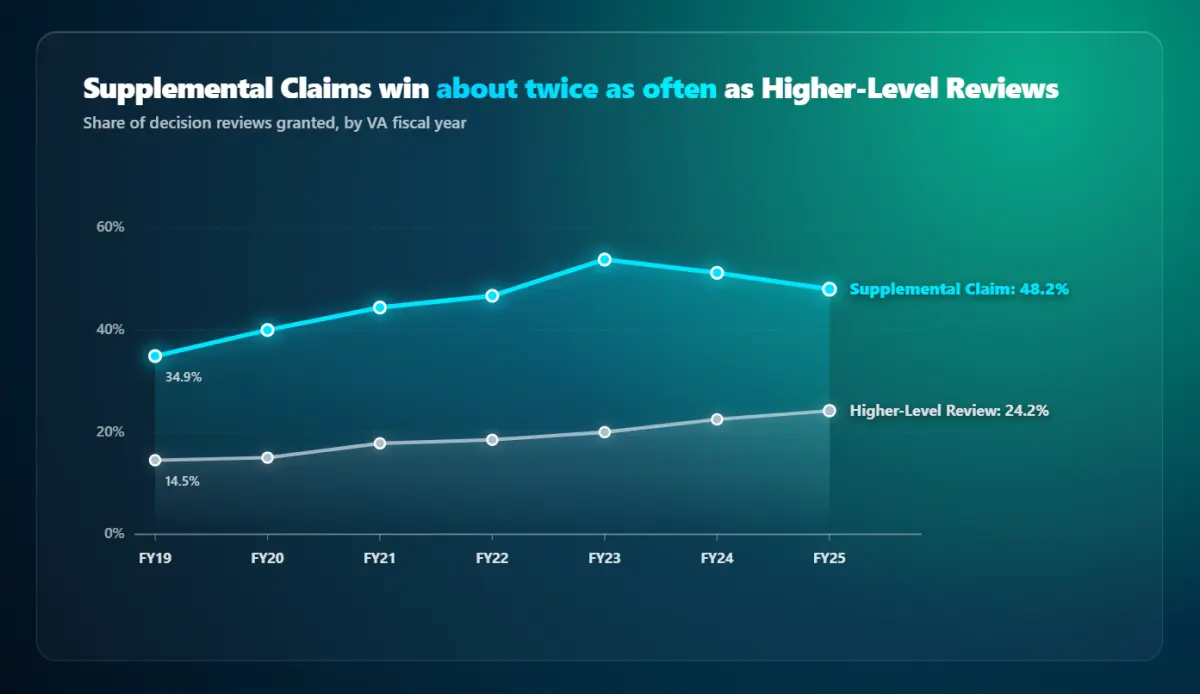
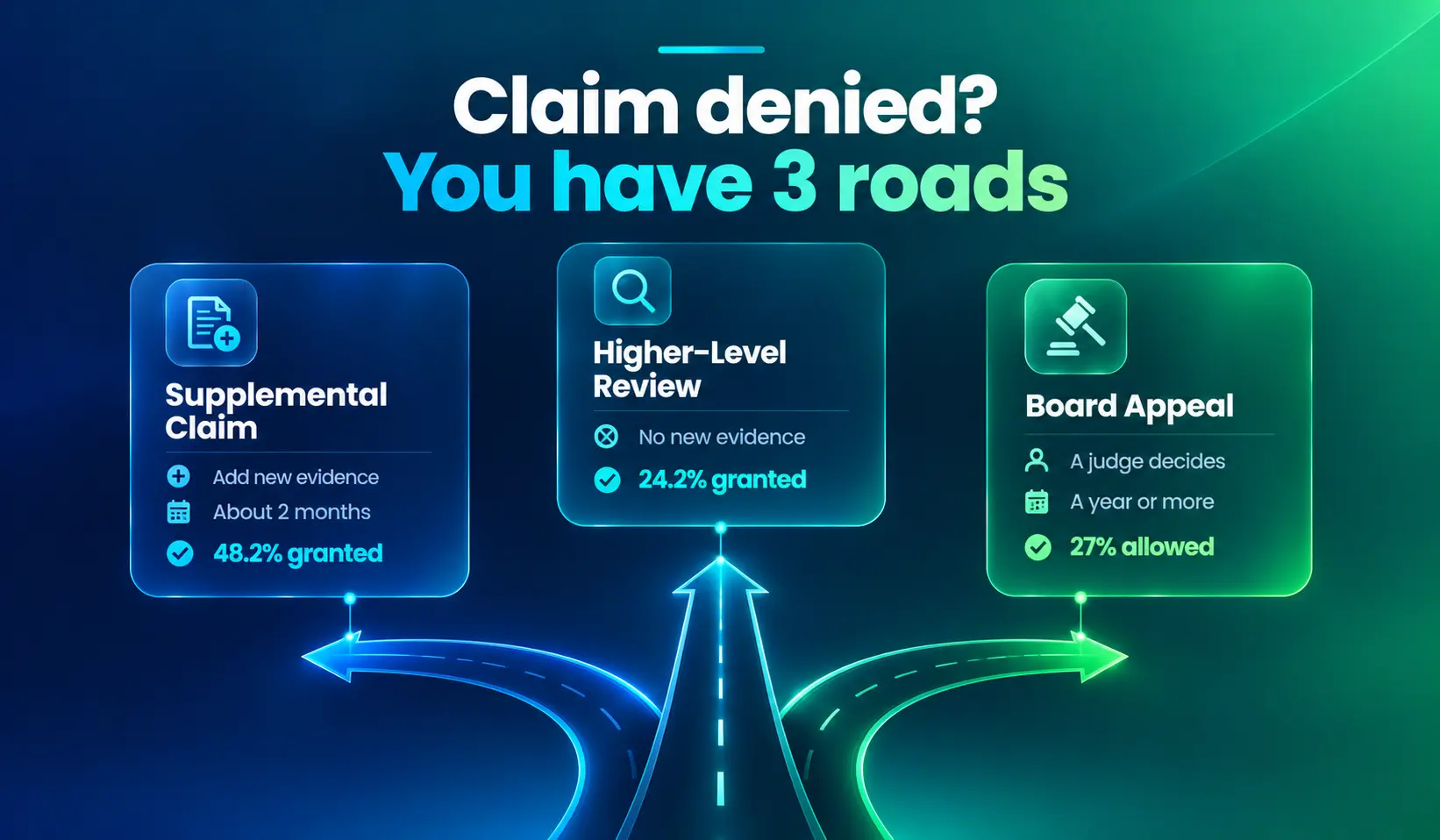
You should choose a supplemental claim when the reason for denial is missing evidence. On the other hand, you should opt for a Higher-Level Review (HLR) when the evidence was already in your file but VA misread it. A Higher-Level Review cannot accept new evidence, which is why its grant rate has stayed about half that of the supplemental lane every year since 2019.
A Board Appeal puts your case before a judge, but it is the slowest path. If an HLR fails, you can still file another one afterward.
How long do you have to file a supplemental claim?
You can file a supplemental claim at any time, but filing within one year of your decision letter protects the effective date (opens in new tab) of your VA disability claim and your back pay. That one-year window is the most important date in your file.
If you think you are among the small handful using this route, you are not. Supplemental claim filings grew about 14-fold from fiscal 2019 to fiscal 2025, much of it after the PACT Act became law in August 2022.
When you file
What usually happens to your effective date
Within 1 year of the decision letter
VA treats it as continuous pursuit, so the effective date can reach back to your original VA disability claim
More than 1 year after the decision
The effective date is usually the date VA receives the new filing
The same one-year window applies after a Higher-Level Review or Board Appeal decision, so you can move between review options without losing your place.
How do you file a supplemental claim?
You file this claim using VA Form 20-0995 (opens in new tab) for disability compensation, or by mail, in person, or through an accredited representative for other benefits. This seven-step checklist makes the filing strong:
Read the “reasons for decision” in your decision letter and write down the elements or information VA said was missing.
Request your claims file and any exam report so you can see exactly what the examiner wrote.
Collect new and relevant evidence that answers each missing element.
Get a nexus letter from a doctor if the link to service was the problem. It should say the condition is “at least as likely as not” related to service, and explain why.
Complete VA Form 20-0995, listing each issue you are contesting and the date of the decision.
Attend any C&P exam VA schedules, answer VA letters quickly, and track your VA disability claim on VA.gov (opens in new tab).
What happens after a C&P exam?
A compensation and pension exam, or C&P exam (opens in new tab), is a medical exam VA may order to gather facts for a VA disability claim, and VA may order another one after you request a decision review. The exam is only one step. Here is what happens after it:
The provider writes an exam report and sends it to VA. The provider cannot tell you the results at the time of the appointment.
VA reviews all the evidence in your file, including the exam report, your medical and service records, and statements from you and others.
VA makes a decision and mails you a decision letter. Timing depends on how complex the claim is and how many conditions you claimed.
If you miss the exam, VA may decide the claim based on the evidence it already has. VA can reschedule the exam (opens in new tab) for a genuine cause, such as a hospital stay or a death in your immediate family. If the report goes against you, a private medical opinion that answers the examiner’s reasoning is usually used as a fix in the next filing.
What evidence fixes a denied VA disability claim?
A successful filing answers the specific reason VA gave, providing evidence for every gap flagged.
If VA said…
Submit this new and relevant evidence
No current diagnosis
A diagnosis from a private or VA provider, ideally on a Disability Benefits Questionnaire
No in-service event
A buddy statement, your own detailed statement, unit records or personnel records
No nexus to service
A nexus letter with a clear rationale and the “at least as likely as not” standard
Negative C&P exam opinion
A private medical opinion that answers the examiner’s reasoning point by point
Rating too low
Current treatment notes and statements on how symptoms affect work and daily life
Toxic exposure not recognized
Service dates and locations showing you qualify for a PACT Act presumption
The last row is the most crucial one for older denials. If your condition became presumptive after VA denied it, the change in law alone can support the claim.
Missing the one-year window and losing months of back pay.
Sending a vague nexus letter that says “possibly” or gives no rationale.
Adding evidence that does not answer the reason VA gave.
Skipping a scheduled C&P exam.
Where can you get VA disability claims help?
You do not have to pay for VA disability claims help. Azimuth offers free VA claims help for veterans: It is a platform that matches you with VA-accredited help and gives you and your accredited representative one shared case record. Veterans Service Organization (VSO (opens in new tab)) representatives also help for free. After you receive a denial communication in your decision letter, evidence and one-year deadline sit in one place, and you can see where your VA disability claim stands without calling.
What should I do if my VA disability claim is denied?
Read the “reasons for decision” in your VA decision letter to find what was missing, then gather evidence that fills that gap. If the denial came from missing evidence, file a supplemental claim on VA Form 20-0995 (opens in new tab) within one year of the decision to protect your effective date.
How long does a supplemental claim take?
VA reported an average of 58.3 days (opens in new tab) to complete a supplemental claim for disability compensation or pension in September 2026, against a goal of 125 days. It can take longer if VA orders an exam or requests outside records.
What is the supplemental claim success rate?
VA granted 48.2% of supplemental claims in fiscal 2025, compared with 24.2% of Higher-Level Reviews (opens in new tab). Claims that answer the exact denial reason, often with a nexus letter, are successful.
Can I file more than one supplemental claim?
Yes. If one is denied, you can file another one with new and relevant evidence, or request a Higher-Level Review or Board Appeal (opens in new tab) instead.
Should I file a supplemental claim or a Higher-Level Review?
File a supplemental claim when you need to add new evidence. Request an HLR when the evidence was already in your file and you believe VA made an error reading it, because that review cannot accept new evidence.
Do I need a VA disability lawyer to file a supplemental claim?
No. You can file online yourself at VA.gov. A VA-accredited attorney, claims agent, or VSO representative can help, and only accredited attorneys and agents may charge fees, after VA decides the initial claim.
What happens after a C&P exam?
After a C&P exam, the provider sends a report to VA, VA reviews it with the rest of your evidence, and then VA mails a decision letter. The provider cannot share results at the appointment, but you can request a copy of the report on VA Form 20-10206 (opens in new tab).
Attorneys, claims agents and VSO representatives can all help with a VA claim, but they differ in training, services and fees. Compare all three and learn how to check accreditation before you choose.
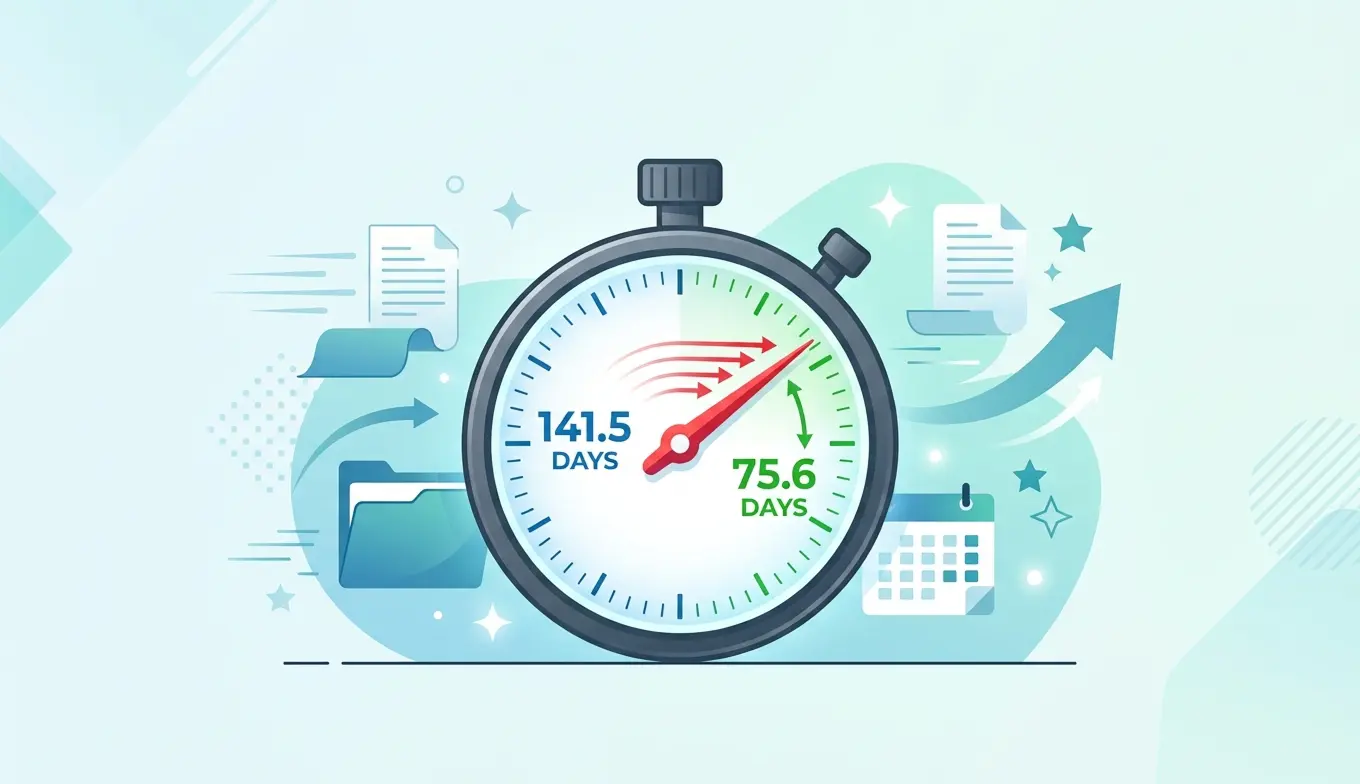
VA now decides disability claims in about 75 days. Here's where the extra volume lands first, and a 10-point checklist to test whether your practice is ready.