VA Claims Agent vs. Accredited Attorney vs. VSO Representative: Which One Should Help With Your Claim?
Attorneys, claims agents and VSO representatives can all help with a VA claim, but they differ in training, services and fees. Compare all three and learn how to check accreditation before you choose.
7 min readBy Azimuth Team
Share
If you need help filing a VA disability claim or appealing a decision, you have three main options: a VA-accredited attorney, a VA claims agent, or a Veterans Service Organization (VSO (opens in new tab)) representative.
Even though all three can help you navigate the VA disability benefits process, they differ in their professional qualifications, services, and fees charged. A VSO representative provides free assistance, while accredited attorneys and claims agents may charge for qualifying services after VA issues an initial decision on a claim.
Your choice depends on where you stand in the claims process, what kind of help you need, and whether you want free or paid representation.
VA claims agent vs. attorney vs. VSO: What's the difference?
Can represent veterans in the U.S. Court of Appeals for Veterans Claims?
Yes, if admitted to practice before the Court
Only if separately admitted under Court rules
Only if separately admitted under Court rules
Common reason to choose
Legal analysis or complex appeal issues
Specialized VA claims and appeals assistance
Free assistance with claims and appeals
All three must hold the appropriate VA accreditation to represent claimants before the Department of Veterans Affairs. A professional title, law license, or affiliation alone does not automatically establish VA accreditation.
What does a VA-accredited attorney do?
A VA-accredited attorney is a licensed lawyer authorized by the Department of Veterans Affairs to represent claimants in matters related to VA benefits. A VA disability lawyer can assist with initial applications, review VA decisions, build supporting evidence, prepare legal arguments, and handle administrative appeals.
You should consider a VA-accredited attorney when:
Your disability claim has been denied and you need help challenging the decision.
Your case involves disputed medical evidence, service connection, or effective dates.
You need a detailed legal analysis of VA regulations and the reasons for a denial.
Your appeal may require representation before the U.S. Court of Appeals for Veterans Claims (CAVC (opens in new tab)).
One important thing to remember: Not every attorney is VA-accredited. A law license alone does not authorize an attorney to represent veterans before VA. For representing veterans in the CAVC, an attorney will need to meet its separate admission requirements.
What does a VA claims agent do?
A VA claims agent is a non-attorney professional accredited by VA to assist claimants with matters related to veterans benefits. To obtain accreditation, claims agents must undergo a character review and pass an examination covering VA law and procedures.
An accredited VA claims agent can help with:
Preparing and submitting disability claims.
Reviewing rating decisions and identifying issues that may need further review.
Organizing medical records, service records, and other supporting evidence.
Communicating with VA on behalf of an appointed claimant.
Unlike an attorney, a claims agent does not need a law degree or state bar membership. However, both accredited claims agents and attorneys can represent claimants throughout VA's administrative claims and appeals process.
When should you choose a VA claims agent? When you need specialized assistance with VA benefits procedures, evidence development, or a decision review, but do not necessarily need a licensed attorney. These agents can charge for qualifying post-decision representation under the applicable fee rules.
What does a VSO representative do?
A VSO representative is an individual accredited through a VSO recognized by VA. These representatives provide free assistance with VA benefits claims. Organizations such as the Disabled American Veterans (DAV), Veterans of Foreign Wars (VFW), and American Legion help veterans access accredited representatives.
A VSO representative can assist with:
Understanding eligibility requirements and available benefits.
Completing and submitting initial disability claims.
Gathering medical and military service records.
Reviewing VA decisions and explaining available review options.
Preparing and pursuing VA administrative appeals.
VSO representatives can assist with both initial claims and appeals. Their services are not limited to straightforward applications.
When should you choose a VSO representative? If you want free assistance with filing a claim, understanding VA requirements, or challenging a decision, a VSO representative is the ideal option.
How much do VA disability representatives charge?
VA-accredited attorneys and claims agents generally cannot charge for services provided before VA issues its initial decision on a claim. They may charge for qualifying post-decision services when applicable appointment and fee-agreement requirements are satisfied. The key difference is between assistance provided before VA issues an initial decision and qualifying representation after that decision.
Stage of claim
VSO representative
VA-accredited attorney
VA claims agent
Before VA's initial decision
Free
Cannot charge for initial-claim services
Cannot charge for initial-claim services
After an initial decision, for qualifying representation
Free
May charge
May charge
How are attorney and claims agent fees calculated?
VA-accredited VSO representatives provide free assistance with preparing and filing claims. VA-accredited attorneys and claims agents may also help with initial claims at no cost, as they are generally prohibited from charging fees before VA issues its initial decision.
After that decision, attorneys and claims agents may charge for qualifying representation. When a fee agreement meets VA's direct-payment requirements, VA can pay the representative directly from the veteran's past-due benefits, also known as back pay. Direct-payment fees cannot exceed 20% (opens in new tab) of past-due benefits calculated before applicable withholdings.
Before signing an agreement, it is vital that you seek clarity on whether the fee depends on a successful outcome, what expenses may be charged separately, and what happens if you change representatives.
There is no single best representative for every veteran. Your choice of representative should be based on the stage of your claim, the issues involved, and the kind of assistance you are seeking.
Your situation
Representative worth considering
Reason
You're filing your first disability claim
VSO representative
Free assistance with forms, evidence, and submission
You received a denial and need to understand your options
VSO, claims agent, or attorney
All three can help evaluate administrative decision-review options
Your claim involves complicated legal or evidentiary questions
VA-accredited attorney or experienced claims agent
Specialized analysis and evidence development may be valuable
You want professional assistance without representation fees
VSO representative
VSO claim representation is free
You're considering an appeal to the CAVC
Attorney admitted to practice before the Court
Court proceedings have separate rules and procedural requirements
These are starting points, not restrictions. An experienced VSO representative may handle a complicated appeal, while an accredited attorney or claims agent may voluntarily assist with an initial claim for free.
Before deciding, ask the prospective representative how much experience they have with your specific type of claim, how they will communicate updates, and who will be responsible for your case.
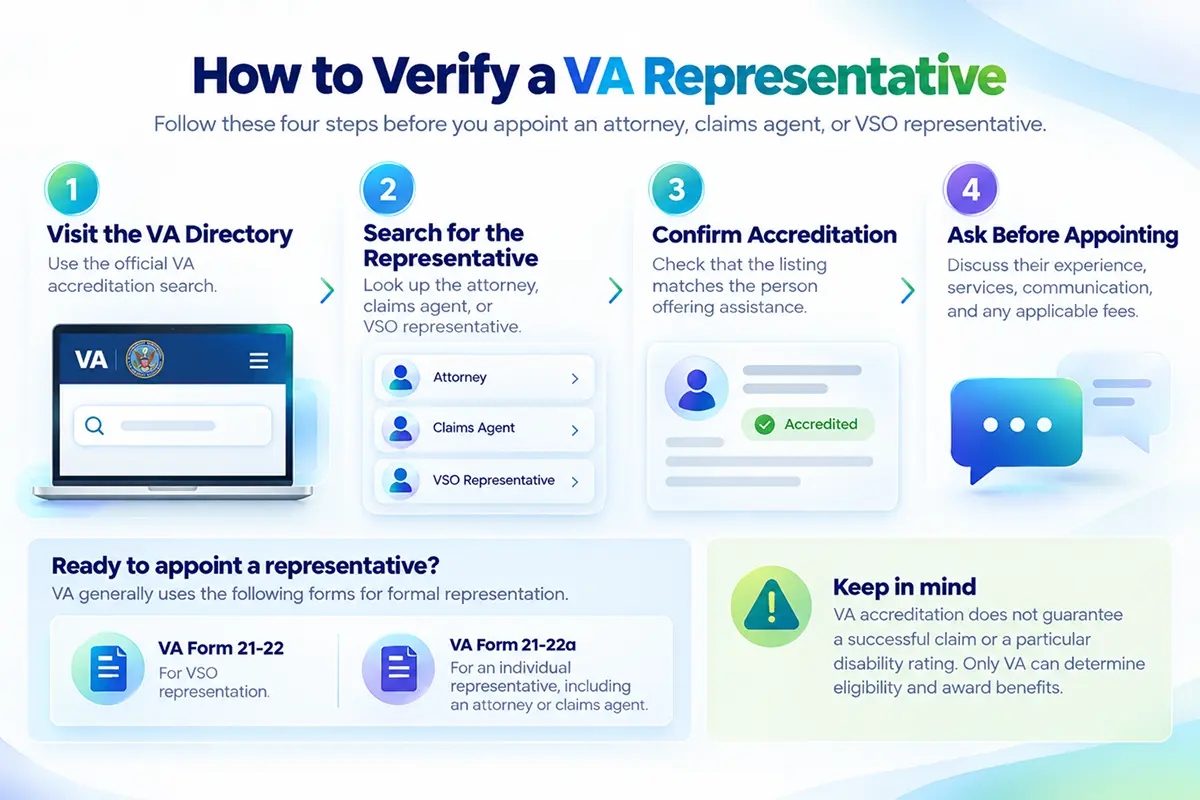
How do you verify whether a VA representative is accredited?
Four steps to verify VA accreditation before choosing a representative.
VA accreditation confirms that an individual is authorized to represent claimants before the Department of Veterans Affairs. It is an essential safeguard against unauthorized claims assistance.
No VA representative ever assures a particular disability rating, promises approval, charges for preparing an initial claim, or refuses to explain their accreditation status. Moreover, VA accreditation also does not guarantee a successful claim. Only VA can determine eligibility and award benefits.
How can Azimuth help you find and work with accredited representation?
Finding an accredited representative is just one part of the process. The major work revolves around maintaining documents, keeping appointments, communicating regularly, and providing claim updates.
Azimuth connects U.S. military veterans with VA-accredited representatives through a secure platform that helps manage the disability claims process. It brings intake, evidence collection, compensation and pension (C&P) exam preparation, claim tracking, and appeals into one place, from initial application through final decision. Its capabilities include representative matching, secure document management, case tracking, and communication tools. The platform is designed to be free for veterans, while independent accredited professionals remain responsible for providing representation.
Final takeaway
A VSO representative offers free assistance with initial claims and appeals. A VA claims agent provides specialized, non-attorney representation, while a VA-accredited attorney can also provide legal representation and may handle court appeals if separately admitted.
Whichever option you choose, ensure that you verify accreditation, understand any fees, and select someone experienced with your type of claim. The representative's qualifications and suitability for your situation matter more than the professional title alone.
Important note
This draft is based on official VA guidance and is intended for general educational purposes. It should not be construed as legal advice.
Frequently asked questions
Can a VA-accredited attorney help with an initial disability claim?
Yes. A VA-accredited attorney can help prepare and submit an initial disability claim but generally cannot charge for services provided before VA issues its initial decision on that claim.
Is a VA claims agent the same as a VA disability lawyer?
No. A VA claims agent is an accredited non-attorney, while a VA disability lawyer is a licensed attorney who must also obtain VA accreditation to represent claimants before VA. Both can assist with VA administrative claims and appeals.
Can a VSO representative help with a denied VA claim?
Yes. Accredited VSO representatives can help veterans review denied claims, prepare decision-review requests, and pursue administrative appeals without charging representation fees.
Can I change my VA representative after filing a claim?
Yes. Veterans can change their appointed representative during the claims process. However, changing representatives may affect existing fee obligations or case coordination. Review any signed agreement before making the change.
Do I need a lawyer to appeal a VA disability decision?
No. A VA-accredited attorney, claims agent, or VSO representative can assist with administrative decision reviews, including Supplemental Claims, Higher-Level Reviews, and Board appeals. Representation before the CAVC entails separate admission requirements.
How long do I have to appeal a VA disability decision?
For many VA disability compensation decisions, veterans generally have one year from the decision notice to request a Higher-Level Review or Board appeal. Supplemental Claims may be filed later, but filing within one year can be important for preserving the effective date. Review the specific deadlines and instructions in your VA decision letter.
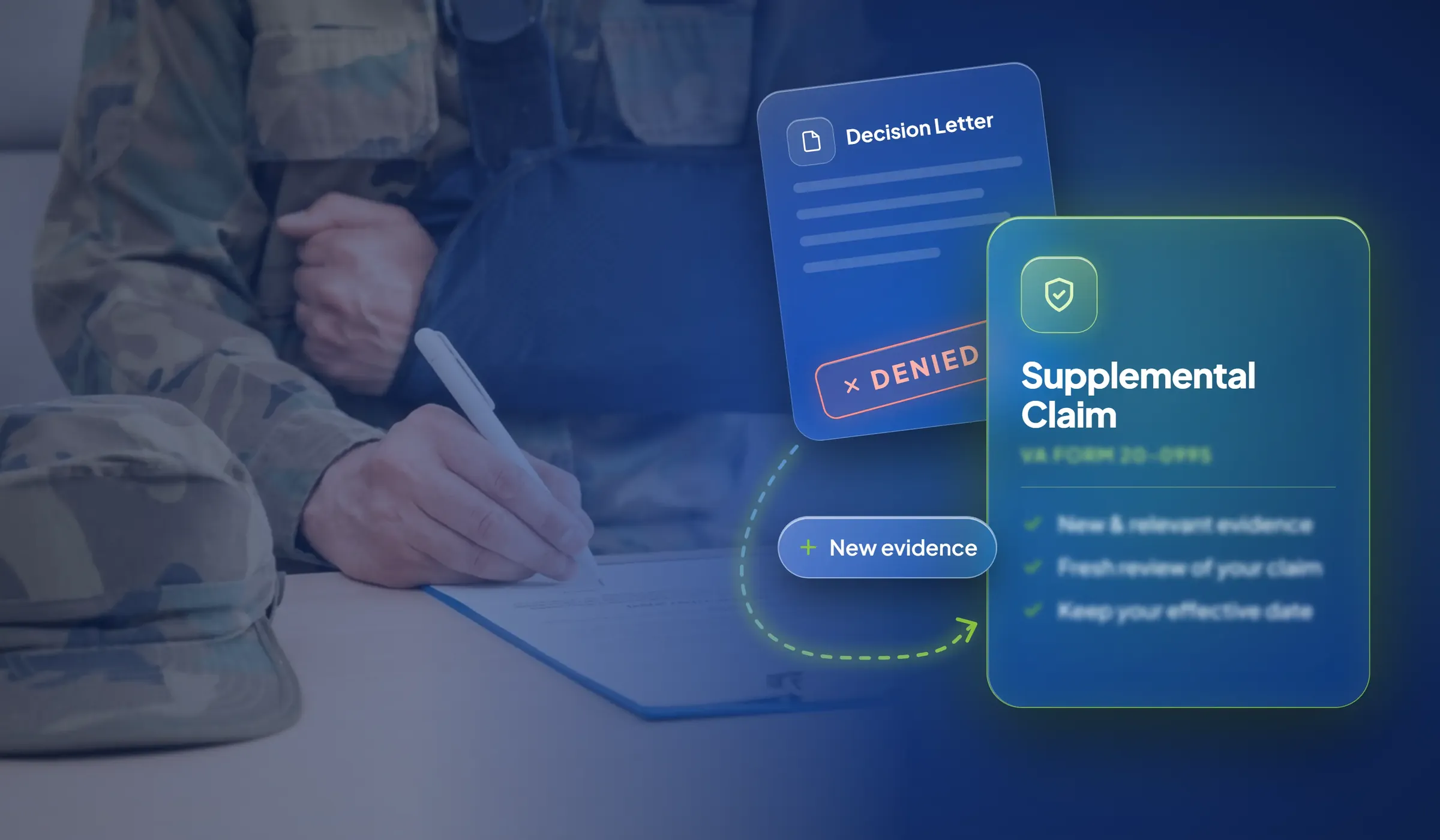
Most denials come down to one missing piece of evidence. Learn how to read your decision letter, what counts as new and relevant evidence, and how to file a Supplemental Claim before the one-year deadline.
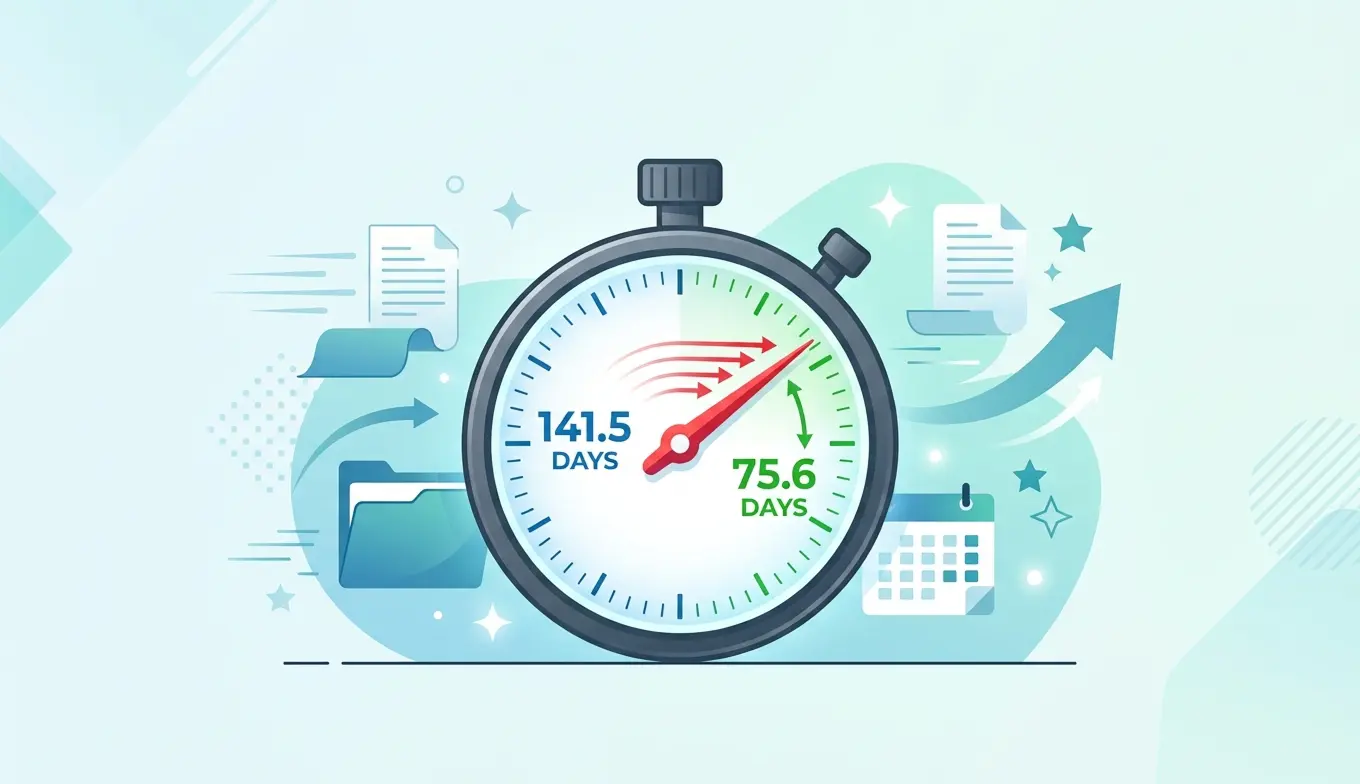
VA now decides disability claims in about 75 days. Here's where the extra volume lands first, and a 10-point checklist to test whether your practice is ready.