VA Accredited Attorneys: Is Your Practice Ready for Faster VA Decisions?
VA now decides disability claims in about 75 days. Here's where the extra volume lands first, and a 10-point checklist to test whether your practice is ready.
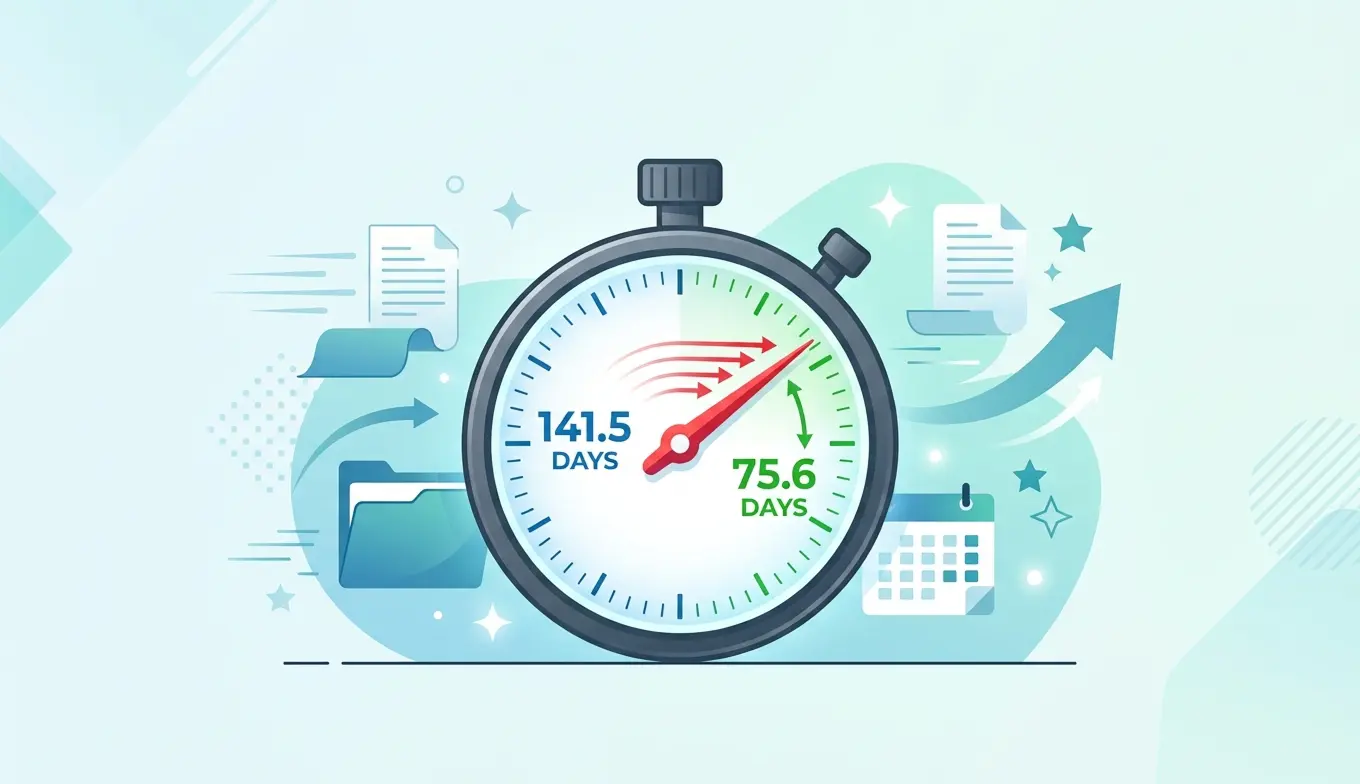
That's how long VA now takes, on average, to decide a disability claim. At the start of 2025, it was more than 140.
For veterans, that's welcome news. For the attorneys, claims agents, and Veterans Service Organization (VSO) representatives who help them, it quietly changes the whole week: decision letters arrive sooner, one-year review clocks start earlier than before, and cases that used to sit for months now need answers right away.
So here's the question worth asking before the next stack of letters lands: Is your practice built for a VA that moves this fast?
This article explains what changed, where the extra pressure lands first, and how to test your practice with a 10-point readiness checklist.
Quick answer
VA's average decision time was 75.6 days in September 2026, nearly half the 141.5 days of January 2025. Faster decisions mean more letters, more open review deadlines and less preparation time per case, so every VA accredited attorney, claims agent and VSO needs deadlines tracked by case, complete intake files and clean handoffs.
What has actually changed
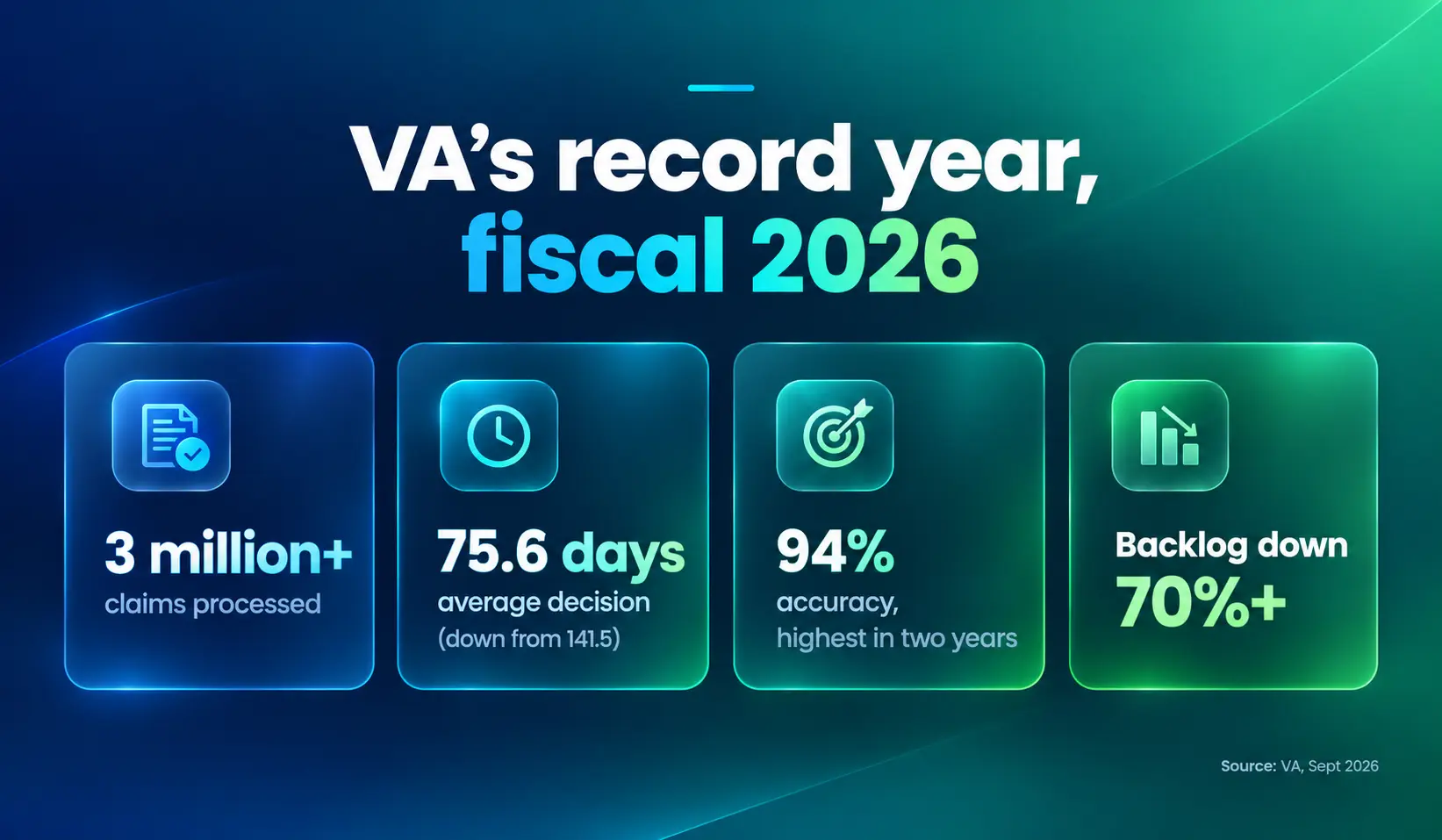
VA closed fiscal 2026 with record speed: more than 3 million disability claims (opens in new tab) processed by September 18, beating the previous year's record of 3.001 million before the year was even over.
Measure
Figure (VA, Sept 2026)
Average VA claims processing time
75.6 days, down from 141.5 on Jan 20, 2025
VA claims backlog
Down more than 70% since January 2025
Claims processing accuracy
94%, the highest in two years
Compensation and pension awarded
More than $207 billion in fiscal 2026
Claims granted
More than 60%
Decisions reviewed by the Board of Veterans' Appeals
About 3%
Two more figures matter for anyone who represents veterans. VA grants more than 60% of claims, and only about 3% of its decisions go on to the Board of Veterans' Appeals.
Read together, these numbers tell a simple story: More decisions are reaching veterans, faster, and most of the follow-up work happens before the Board, in Supplemental Claims and Higher-Level Reviews. That is where accredited representatives spend much of their time.
Why faster decisions mean more work, not less
A faster VA only compresses a representative's workload; it does not reduce it. The same cases still need to be read, explained, and often require a recommended next step. Now, all these need to be coordinated and completed within a tighter deadline.
The following are the areas where most practices will feel the load first:
More decision letters per week. Every letter needs a careful read, a call or message to the veteran, and a decision about what comes next.
More review deadlines open at once. Each decision starts its own one-year clock. Faster decisions mean more of those clocks running side by side.
Veterans with less time to prepare. A claim that moves in 75 days leaves less room to gather records or buddy statements before a decision lands.
Fee events sooner. Accredited attorneys and claims agents cannot charge for work on an initial claim before VA decides it (38 CFR 14.636 (opens in new tab)). Faster first decisions bring the point where paid representation can begin forward, along with the paperwork that comes with it.
Handoffs under pressure. When a VSO representative refers a case to an attorney for review, the file has to move quickly and arrive complete.
None of this is bad news. However, it does mean a practice that has not organized and optimized its processes and resources will feel the strain sooner and heavier than expected.
The clocks that start with every decision
Every decision letter opens a one-year window for most VA benefits. If missed, the options narrow rapidly. Faster decisions don't change the rules, but they put more of these windows on your desk at the same time.
Option
Deadline
New evidence?
VA's goal time
VA Supplemental Claim
Any time; within 1 year keeps the effective date
Yes, new and relevant evidence
Average of 125 days
Higher-Level Review
Within 1 year of the decision letter
No
Average of 125 days
VA Board Appeal
Within 1 year of the decision letter
Only on the Evidence Submission or Hearing docket
365 days on the Direct Review docket
Two details are easy to lose here. After a decision review, a new one-year window opens for the next step. And once a year has passed after a review decision, the only path left is a Supplemental Claim.
For a practice, that means every case can carry more than one live deadline over its life. Tracking them by case, not by memory, is the single biggest protection you can give your clients.
VA's accuracy currently stands at 94% (opens in new tab), its best in two years. That's genuine progress. It also means that, by VA's own measure, roughly 6 in every 100 decisions are still incorrect. At more than 3 million claims a year, that is a lot of veterans.
The practical lesson for representatives is the same as it has always been, only more urgent:
Read the whole letter, not just the rating. Check each condition, the effective date and the reasons given.
Compare it with the evidence in the file. A record VA didn't mention may point to a Higher-Level Review; a gap may point to a Supplemental Claim.
Explain it to the veteran in plain words. A faster decision can feel abrupt. Veterans trust the representative who tells them what it means and what happens next.
Speed helps veterans most when someone they trust has read the decision before they decide what to do about it.
A readiness checklist for your practice
Whether you're a solo VA accredited attorney, a claims agent with a few dozen clients, or a county VSO office, these checks will tell you how ready you are for a faster VA.
Deadlines
Every open case shows its next deadline in one place, not in individual inboxes.
Someone gets a reminder at 90, 60, and 30 days before each one-year window closes.
Intent to File dates are tracked alongside decision dates.
Intake
New clients arrive with their decision letters, records, and contact details in one complete file.
You can see at a glance which new cases are initial claims and which are reviews.
Fee agreements are signed and filed with VA before paid work starts.
Decisions
Each new decision letter is logged the day it arrives and assigned to a person.
You have a standard way to explain a decision to a veteran, in writing, within a week.
Handoffs
When a VSO representative refers a review to an attorney or agent, the full history moves with it.
The veteran always knows who is handling their case today.
If you ticked fewer than seven, faster decisions will probably feel more like stress before they start feeling more like progress.
Where a veteran case management platform helps
Spreadsheets and inboxes work fine until the volume spikes. Then the cost shows up as missed reminders, repeated questions, and files that can't be found when a veteran calls.
A good VA claims software for attorneys, claims agents, and VSO offices should do four things well:
Show every deadline by case, including the one-year review windows and Intent to File dates.
Keep one record per veteran, so evidence, letters and notes are not scattered all across the system.
Make handoffs clean, so a case referred from a VSO representative to an attorney arrives complete.
Keep the veteran informed, so follow-up calls are fewer and less frequent.
That is what we are building at Azimuth: a free way for veterans to find VA-accredited help, and one shared case record that the veteran and their accredited representative both work from. Matched cases arrive organized, deadlines are tracked by case, and the veteran can see where things stand without needing to call to know if their case has progressed.
If you're an accredited attorney, claims agent, or VSO leader, we'd like to show you how it works. Book a demo at azimuth.claims.
The bottom line
A faster VA is good for veterans. Whether it's good for your practice depends on what happens the day a decision letter arrives.
The representatives who do well over the next year will be the ones who keep a watchful eye on every deadline, store every file in one place, and communicate to every veteran what comes next, before the veteran has to ask.
Frequently asked questions
How fast is the VA deciding disability claims now?
In September 2026, VA reported an average of 75.6 days to complete a decision, compared with 141.5 days in January 2025.
Does a faster decision change the deadline for a review?
No. For most benefits, a Higher-Level Review or a VA Board Appeal must still be requested within 1 year of the decision letter. A VA Supplemental Claim can be filed at any time, but filing within a year keeps the effective date.
Can a VA-accredited claims agent or attorney charge for filing an initial claim?
No. VA-accredited claims agents and attorneys cannot charge veterans for preparing or filing an initial claim. They may charge for eligible services after VA issues its initial decision, subject to a valid fee agreement with VA. Accredited VSO representatives provide assistance free of charge to veterans.
What should a VSO representative do when a case needs an attorney?
Refer it early, with the full file and every deadline marked, so the attorney or claims agent has time to act within the one-year window.
What is a veteran case management platform?
Software that keeps each veteran's claim, evidence, deadlines and messages in one record, shared by the veteran and their accredited representative.
Attorneys, claims agents and VSO representatives can all help with a VA claim, but they differ in training, services and fees. Compare all three and learn how to check accreditation before you choose.
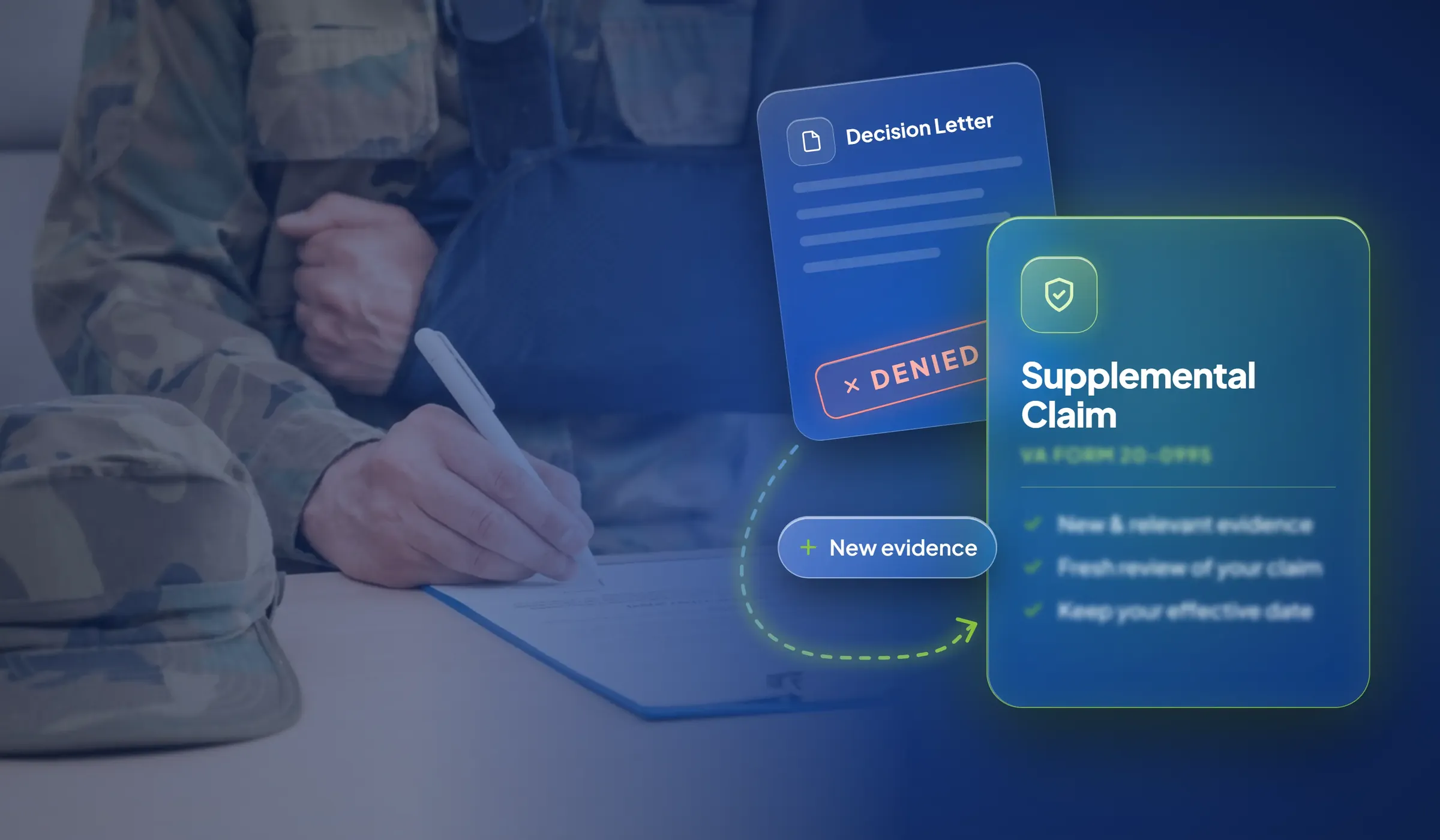
Most denials come down to one missing piece of evidence. Learn how to read your decision letter, what counts as new and relevant evidence, and how to file a Supplemental Claim before the one-year deadline.