The Complete Guide to Filing a VA Disability Claim
A step-by-step guide to filing a VA disability claim: who's eligible, what evidence to gather, how to apply online, what happens after you file, and what to do if VA denies your claim.
As a Veteran, you may qualify for disability payments from the Department of Veterans Affairs (VA) if you develop deteriorating physical, mental, or cognitive conditions that have resulted from their military service. Filing a VA disability claim starts with identifying your service-connected conditions, gathering the right evidence, and submitting an accurate application. You may also need to attend medical examinations, provide additional documents, and review VA's final decision.
If you're wondering how to file a VA disability claim, this guide covers the complete process, from checking eligibility and applying online to understanding disability ratings and challenging a decision.
You have a current illness or injury (known as a condition) that affects your mind or body, and
You served on active duty, active duty for training, or inactive duty training
You will also have to meet one of these secondary criteria to qualify:
In-service disability claim: You got sick or injured while serving in the military and can link this condition directly to your illness or injury, or
Pre-service disability claim: You had an illness or injury before you joined the military, and serving worsened it, or
Post-service disability claim: You have a disability related to your active-duty service that appeared after you ended your service.
Additionally, for some conditions, VA “presumes” that your service caused your condition, called as presumptive conditions. If you have a presumptive condition, you don’t need to prove that your service caused the condition. You only need to meet the service requirements for the presumption.
There are three categories covered under presumptive conditions:
A chronic illness that develops within 1 year of service discharge;
An illness caused by toxic chemicals, contaminants, or other hazardous materials during service; and
An illness contracted during your time spent as a prisoner of war (POW).
Eligibility can also vary by service type, discharge status, and condition. The PACT Act (opens in new tab) also expands VA healthcare and benefits for Veterans exposed to burn pits, Agent Orange, and other toxic substances.
What evidence do you need for a VA disability claim?
VA needs to determine whether your condition is connected to military service and how severely it affects you. For original claims, the evidence (supporting documents) needs to establish three things:
A current physical or mental health disability.
An injury, illness, or event during military service.
A connection, often called a medical nexus, between your current disability and military service.
Depending on your claim, you will need to gather the following:
Evidence
Why it matters
DD214 or separation documents
Establishes military service information
Service treatment records
Documents relevant injuries, illnesses, or treatment
VA and private medical records
Establishes diagnosis, symptoms, treatment, and severity
Medical opinions
May help establish a connection to service
Lay or buddy statements
Provides firsthand observations of events or symptoms
Buddy statements can come from fellow service members, family members, or others familiar with your condition. VA Form 21-10210 (opens in new tab) can be used to submit these statements. Not every claim requires the same evidence. Secondary and presumptive claims have different requirements. VA may also obtain federal records or arrange a medical examination when needed.
Practical tip
Organize documents by the condition you're claiming. This makes it easier to identify missing records and explain how each piece of evidence supports your application.
Should you submit an Intent to File VA claim?
An Intent to File notifies VA that you plan to apply for benefits. It can protect an earlier effective date (or potential start date) while you gather evidence. The effective date is crucial as it determines when your compensation entitlement begins.
You generally have one year after submitting an Intent to File to complete your application and preserve that potential date. You can submit an Intent to File using VA Form 21-0966 (opens in new tab), through VA.gov, or through other VA-supported methods.
Important note
If you begin your disability compensation application online while signed in with a verified account, VA automatically establishes the potential claim date. You don't need a separate Intent to File for that application, provided you complete it within 365 days. An Intent to File does not guarantee benefits or back pay. Your effective date ultimately depends on VA's rules and decision.
How to file a VA disability claim online: Step-by-step instructions
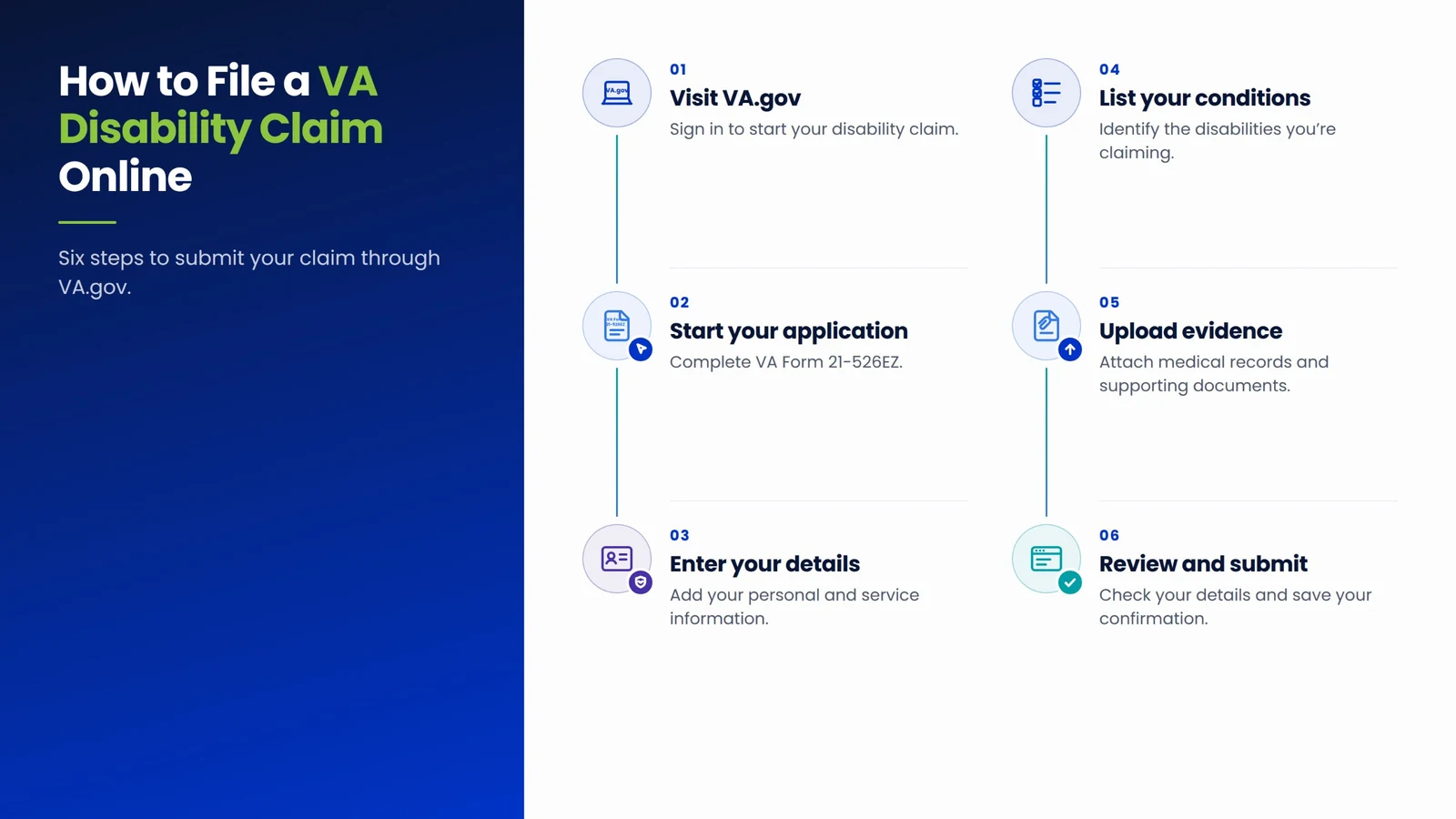
Six steps to file your VA disability claim online through VA.gov.
Filing online through VA.gov is the first and the most direct way to submit your application.
Start by filling out the Application for Disability Compensation and Related Compensation Benefits (VA Form 21-526EZ (opens in new tab)). You can save your progress and return to the application later.
Step 3: Enter your service and personal information
Provide the requested personal details, military service history, contact information, and other necessary information. Check that the details match your service records.
Step 4: Identify the conditions you're claiming
List each disability for which you're requesting compensation. Describe the condition accurately and provide relevant information about when it began, how it relates to service, and any treatment you've received prior to your application.
Step 5: Attach supporting evidence
Upload relevant medical records, service documents, statements, and other supporting materials. If VA needs to obtain records on your behalf, identify the relevant providers or agencies and provide any required authorization.
Step 6: Review and submit
Check your application for missing conditions, inaccurate dates, incomplete information, and document-upload errors. Submit the application and save your confirmation.
Other ways to file a VA disability claim
Besides online, you can also file a disability claim through the following means by submitting the same VA Form 21-526EZ:
By mail: Print the form, complete the application, and send it to the Department of Veterans Affairs Claims Intake Center in Janesville, Wisconsin. You can get the full address here (opens in new tab).
In person: Visit a VA regional office near and submit the physical form in person.
By fax: Send your application to the appropriate VA claims fax number, depending on whether you are in the U.S. or outside.
With assistance: Work with a VA-accredited attorney, claims agent, or Veterans Service Organization (VSO) representative for help in filing a disability compensation claim.
Fully Developed Claim vs. Standard Claim: What's the difference?
A Fully Developed Claim (FDC) is an optional fast-lane VA disability claim process in which you submit all available supporting evidence at the time of filing, potentially shaving off weeks or even months off the processing time. An FDC is available for several types of claims including original disability claims, Dependency and Indemnity Compensation (DIC) claims for survivors, increased disability compensation, among others. To file an FDC, you will need to complete VA Form 21-526EZ, select the FDC option, and submit your supporting documents. The FDC is risk-free: if additional evidence gathering is required, VA will simply move your claim to the standard lane without affecting your back pay, benefits, or effective date.
Important note
Even on an FDC, VA will schedule a Compensation and Pension (C&P) exam if they determine one is needed to evaluate your condition.
On the other hand, a Standard Claim is a VA disability claim in which you submit your application with the available evidence. Under its “duty to assist”, VA helps obtain additional records such as medical records, military service resources, and other documents needed to evaluate it. Unlike an FDC, you don't need to gather all supporting evidence before filing. However, collecting additional evidence increases your processing time.
The two differ in one key aspect: who gathers the evidence. This difference is what ultimately determines the processing timelines.
Fully Developed Claim (FDC)
Standard Claim
You submit all available supporting evidence with your application.
VA takes the responsibility for gathering identified evidence.
You certify that no additional evidence is needed.
VA may request records from federal and authorized private sources.
May result in faster processing.
Likely to take longer because evidence gathering is conducted by VA.
A Fully Developed Claim is the best option when your supporting records are ready. A Standard Claim may be more suitable when important evidence still needs to be obtained.
Important note
Neither an FDC nor a Standard Claim guarantees approval. Choose based on the evidence available, not simply the possibility of a faster decision.
What happens after a disability claim is submitted?
After you submit your claim, VA reviews your application and supporting evidence. The process generally consists of eight stages:
Claim received: VA confirms receipt of your application. If you have filed the claim online, you will see an on-screen message upon submission. If you have filed it by mail, you will receive a confirmation letter in about 1 week.
Initial review: VA checks for basic information and contact you if there are any missing details.
Evidence gathering: VA collects records, requests information, or schedules C&P examinations.
Evidence review: VA evaluates the available evidence. If it needs more evidence or you submit additional documents, the process goes back to the previous stage.
Rating: VA determines service connection and applicable disability ratings.
Preparing decision letter: VA documents its findings and compensation determination in its decision letter.
Final review: A senior reviewer conducts a final check before issuing the decision letter.
Claim decided: Your decision letter becomes available for you to review and download.
What is a C&P exam?
A Compensation and Pension (C&P) exam helps VA evaluate your claimed condition and, when necessary, its relationship to military service. If VA schedules an examination, you must attend it and explain your symptoms accurately. You must answer in detail how they affect your daily activities and functioning. A C&P exam is an evaluation for benefits, not a routine treatment appointment. Missing one without an acceptable reason can affect your claim. You can monitor the progress of your application through the VA claim status tool (opens in new tab).
How long does a VA disability claim take?
According to VA, disability-related claims completed in September 2026 took an average of 68.2 days (opens in new tab). In general, disability claim processing times depend on the complexity of the application, available evidence, examination requirements, and VA's workload. This is an average, not a guaranteed or fixed timeline. Claims requiring additional medical opinions, records, or examinations may take longer.
To help avoid unnecessary delays, you should respond promptly to any request communicated by VA, attend scheduled examinations, and submit complete, accurate information.
How do you understand your VA disability rating and decision?
Once VA completes its review, you'll receive a decision letter explaining which conditions were approved or denied. For approved conditions, VA assigns disability ratings (opens in new tab) based on its rating criteria. Individual ratings generally range from 0 to 100 in 10% increments. If you have multiple service-connected disabilities, VA uses a combined-rating calculation rather than simply adding the percentages together.
Your decision letter usually includes:
Approved and denied conditions.
Individual and combined disability ratings.
Effective dates.
Monthly compensation amounts, if payable.
Reasons for the decision and available review options.
A 0% service-connected rating may still establish eligibility for certain benefits, even when it doesn't result in monthly disability compensation.
You should review the entire letter thoroughly, paying particular attention to the evidence considered, reasons for denial, and effective dates.
What if your VA disability claim is denied?
A denial does not mean you are out of options. For most decisions under the current review system, VA offers three routes:
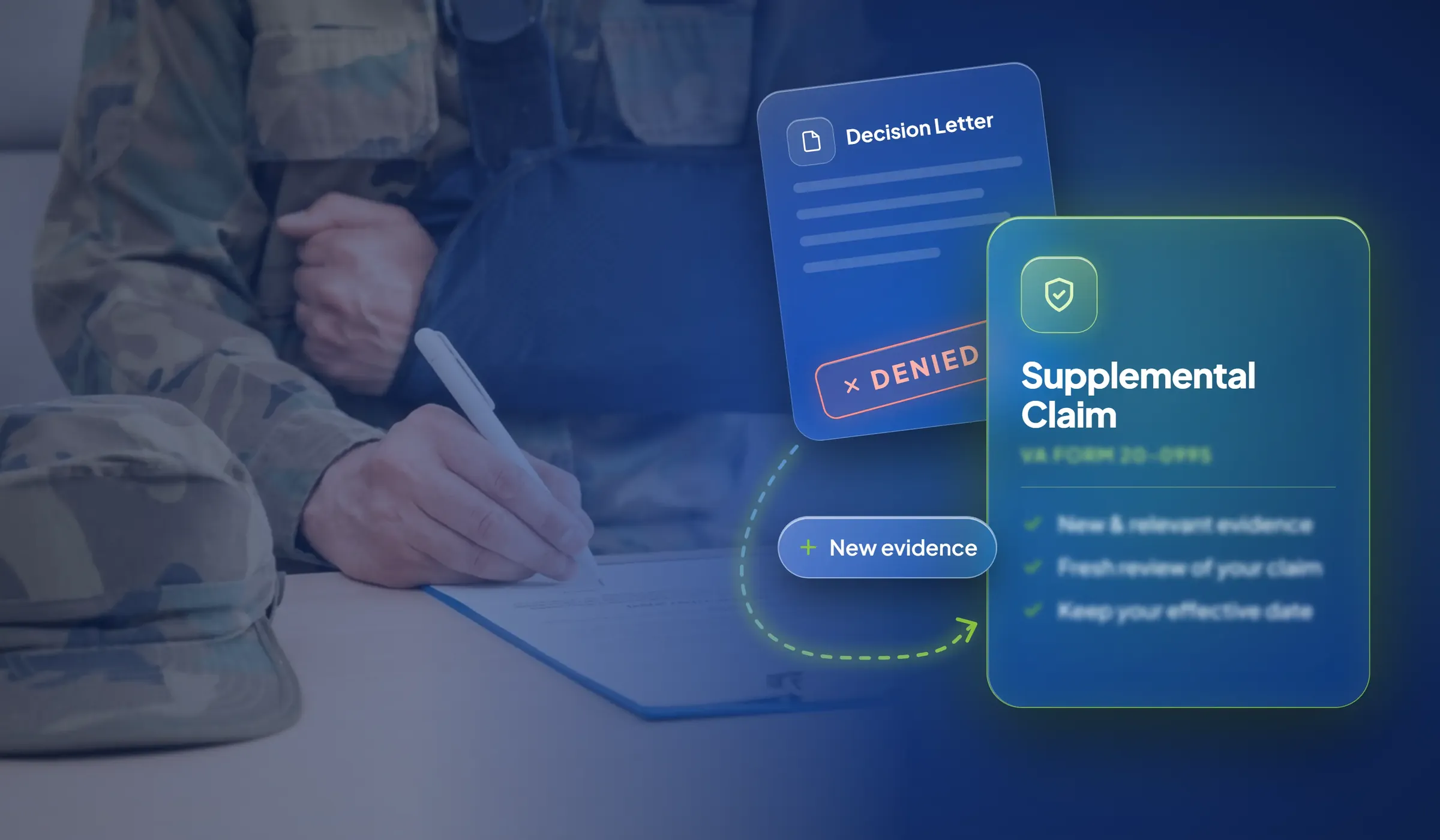
Supplemental Claim: Submit or identify new and relevant evidence that VA did not previously consider.
Higher-Level Review: Request a new review (opens in new tab) by a senior VA reviewer using the existing evidentiary record. You cannot submit new evidence through this option.
You generally have one year from the decision date to request an eligible review option and preserve continuous pursuit for effective-date purposes. The route you take depends entirely on why VA denied your claim and whether additional evidence is available.
How can you increase your VA disability rating?
If an existing service-connected condition has worsened, you may file a claim for increased disability compensation. To support a claim for an increased rating:
Review your current rating and the applicable disability criteria.
Gather updated medical records showing the condition has worsened.
Document changes in symptoms, severity, and functional limitations.
File an increased-rating claim using the appropriate VA application.
Attend any additional C&P examination VA schedules.
An increased rating is not automatic. VA evaluates the current evidence against its rating criteria, and a new review may result in an increased, unchanged, or, where legally appropriate, reduced rating. If you disagree with a recent rating decision rather than experiencing a subsequent worsening, a decision review would be the right choice.
Filing a VA claim after discharge
You can generally file a VA disability claim years after leaving military service. There is no universal deadline for submitting an original disability compensation claim. However, filing dates can affect when your benefits commence, and older claims may require additional evidence to establish service connection. Some conditions qualify for presumptive service connection based on when symptoms develop or other qualifying circumstances.
In any event, whether you're about to be discharged or have been out of service for decades, ensure that you have gathered the relevant service and medical records and any other evidence before applying.
Common mistakes to avoid when filing a VA disability claim
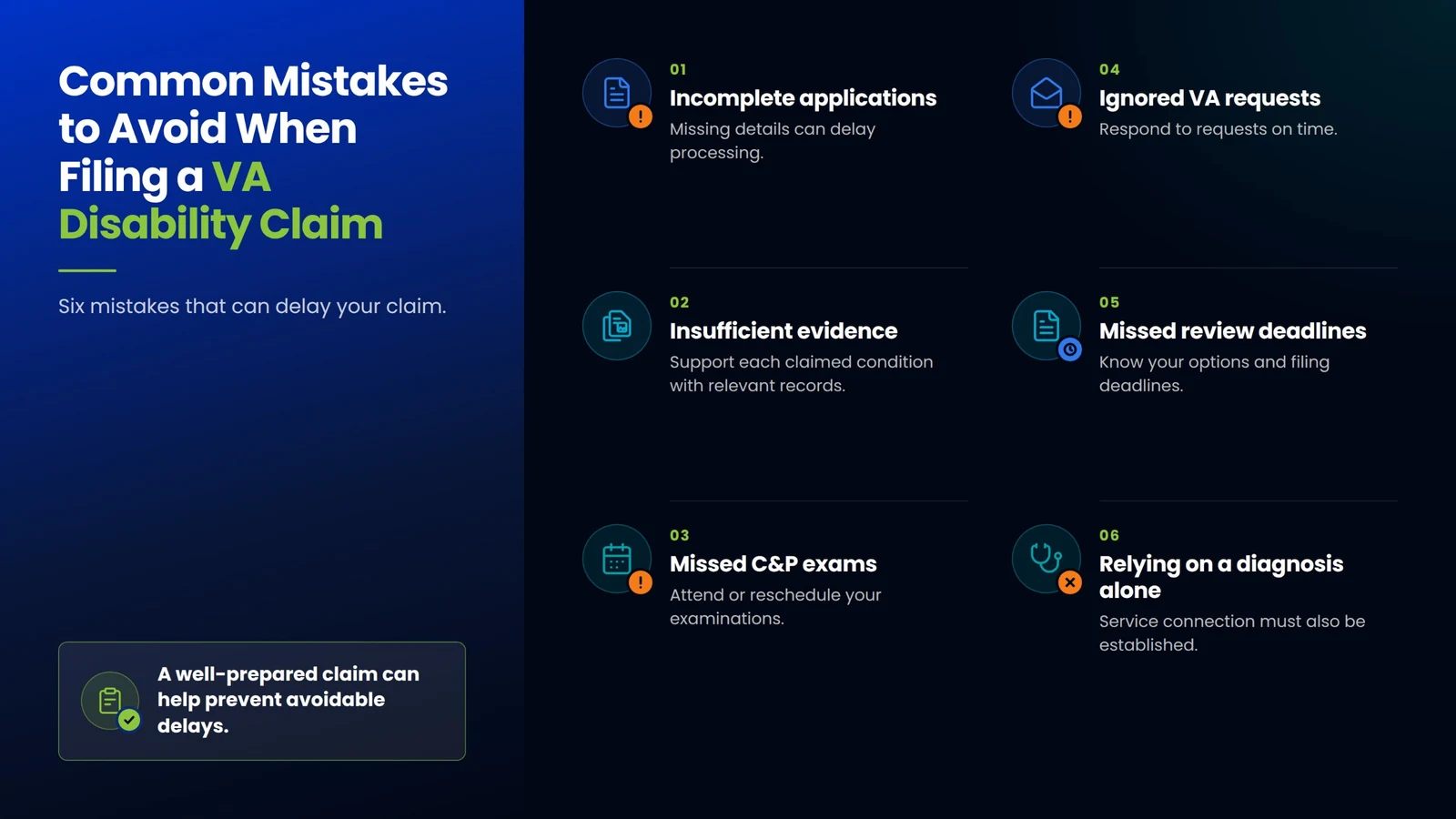
Six common mistakes to avoid when filing a VA disability claim.
Even a legitimate claim can encounter delays or evidence-related issues. Some of the most common mistakes observed when filing a disability claim include:
Incomplete applications: Missing information can trigger additional VA requests.
Insufficient supporting evidence: Explain how the evidence relates to each claimed condition.
Missing examinations: Attend scheduled C&P exams or contact VA promptly if rescheduling is necessary.
Ignoring correspondence: Check claim updates and respond to requests within the specified deadlines.
Missing review deadlines: Understand your decision review options and their time limits.
Assuming a diagnosis guarantees approval: VA generally also needs evidence establishing the required connection to service.
A complete, well-supported application does not guarantee approval, but it can help VA evaluate the claim with fewer preventable interruptions.
Take the next step with a well-prepared VA disability claim
A well-prepared VA disability claim starts with an accurate application, relevant supporting evidence, and a clear understanding of the filing process. Knowing what to submit, what to expect from VA, and how to respond to a decision can help you avoid unnecessary delays and setbacks.
Azimuth is developing a secure platform where veterans can connect with VA-accredited representatives and work with them throughout the claims process. The platform provides Veterans a simpler way to organize medical records, service documents, and supporting statements, while accredited representatives can review claim information, identify missing evidence, and coordinate next steps. The platform is also designed to support C&P exam preparation, centralize claim-related communication, and track important updates, helping both veterans and their representatives stay aligned from initial filing through VA's decision.
Get early access to Azimuth and discover a more connected way to prepare, manage, and track your VA disability claim with accredited support.
Frequently asked questions
Can I file a VA disability claim without a lawyer?
Yes. You can file directly through VA.gov or work with a VA-accredited VSO representative, claims agent, or attorney. VSO representatives provide free assistance. Accredited attorneys and claims agents are generally prohibited from charging fees for services provided before VA issues its initial decision on a claim.
Can I file a VA disability claim years after discharge?
Yes. Veterans can generally apply years after separation. However, proving service connection may require additional documentation, and the effective date for compensation will depend on applicable VA rules.
Can I submit additional evidence after filing?
Yes. VA generally allows evidence submission for up to one year after receiving your claim. However, submitting additional evidence can affect processing, and a Fully Developed Claim may be converted to a Standard Claim.
What happens if I miss my C&P exam?
Missing a required examination can affect VA's ability to evaluate your claim and may lead to an unfavorable decision. Contact VA or the examination contractor as soon as possible if you cannot attend and need to reschedule.
Can I increase my VA disability rating after receiving a decision?
Yes. If your service-connected condition worsens, you can file for an increased rating with updated supporting evidence. If you believe the original rating decision was incorrect, consider the appropriate decision review option instead.
Attorneys, claims agents and VSO representatives can all help with a VA claim, but they differ in training, services and fees. Compare all three and learn how to check accreditation before you choose.
Most denials come down to one missing piece of evidence. Learn how to read your decision letter, what counts as new and relevant evidence, and how to file a Supplemental Claim before the one-year deadline.
Case tooling built around accreditation requirements. Azimuth does not promise any minimum number of matched veterans, signed clients, fees or claim outcomes, or that any veteran will choose or retain you.